

Charles Scott Gallery
KIYOSHI SAITO Signed Woodcut Print Rokugatsu no Kamakura Kamakura from June 1976 #34 of 100
KIYOSHI SAITO Signed Woodcut Print Rokugatsu no Kamakura Kamakura from June 1976 #34 of 100
Couldn't load pickup availability
KIYOSHI SAITO Signed Woodcut Print
"Rokugatsu no Kamakura" or "Kamakura in June," 1976
Number 34 of an Edition of 100
Comes with a Charles Scott Gallery Certificate of Authenticity
Kiyoshi Saitō (斎藤 清, Saitō Kiyoshi; April 27, 1907 – November 14, 1997, born in Aizubange, Fukushima) was a sōsaku-hanga artist in 20th-century Japan. This is a very rare woodcut print my this master from Japan. Kamakura was his home with his wife until she died.
Size: approximately 18 1/8" x 24" (with a deckled edge)
Signed: in ink in Roman script Kiyoshi Saito
Watermark: Roman letters Kiyoshi Saito
Titled: in Japanese in pencil and dated as well
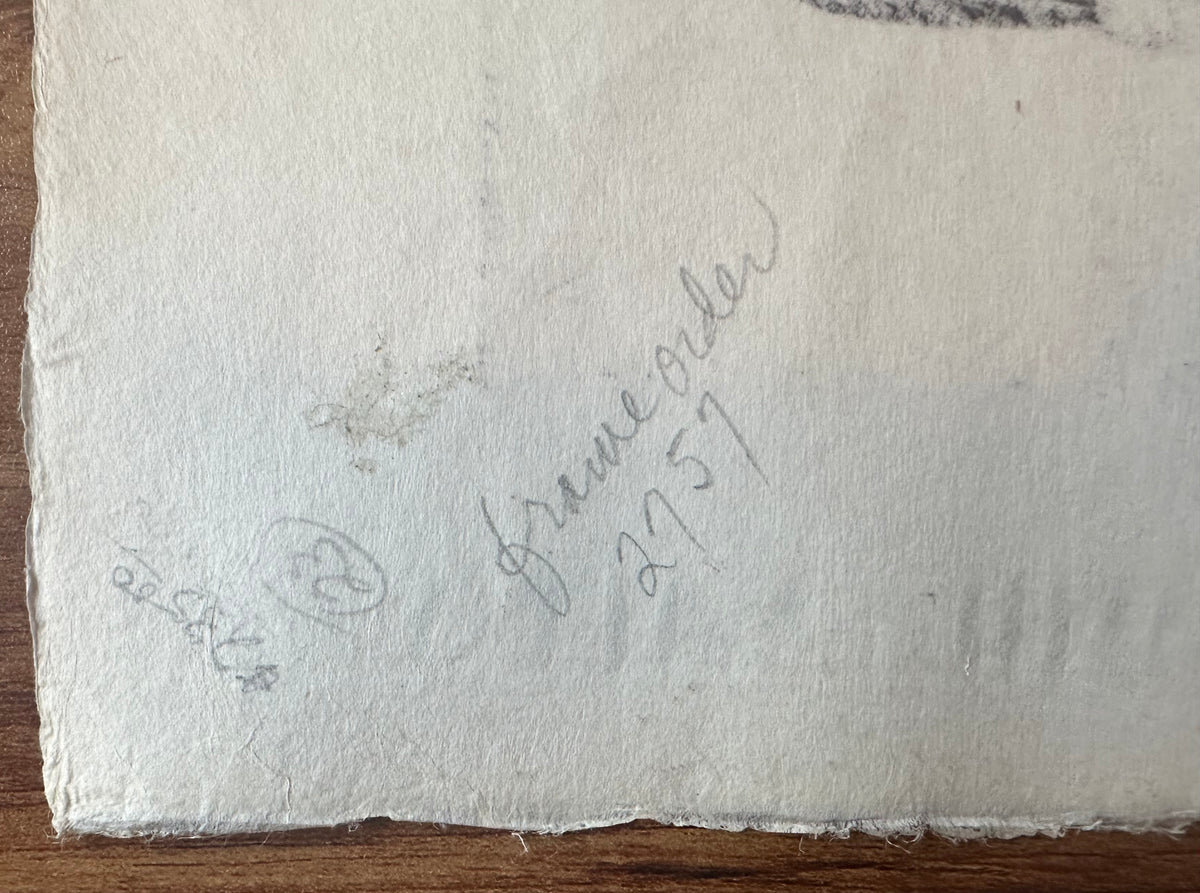
Condition: some waviness to edges and hint of discoloration (though it doesn't present in person as noticeable as in pictures), hinge-mount tape residue on back from previous mounting, upper left corner margin has some paper issue (not perforating), lower left corner looks like a corner-fold though the art was presented this way. Old framing order information in graphite on BACK lower-left corner.
May ship in a tube.
More about the artist: Saitō was one of the first Japanese printmaking artists to win at the São Paulo Biennale, sharing the first prize with Komai in 1951; the award brought the modern Japanese print school to international prominence and awakened the Japanese art establishment itself.
Saitō appeared in Oliver Statler's Modern Japanese Prints: An Art Reborn (1956), by which time he was already popular in the West, and became a printmaking teacher in Ann Arbor, Michigan (1956-57). He visited the United States in 1956 under the auspices of the State Department and the Asia Foundation, and also won a major prize at the international competition in Ljubljana that year; from that point he exhibited widely across the United States and Europe, making printmaking his primary occupation.
Following these honors, Saitō's work became something of a vogue in the West through the 1950s and 60s, combining a recognizably Eastern aesthetic with clear European influences. Exhibiting across Europe, Asia and the United States in the following years, appreciation for Saitō's dedication to his craft continued to grow. Recognized as a true master, he was honored in 1967 with an invitation to design the cover of Time Magazine featuring Prime Minister Eisaku Satō, before being decorated with two of Japan's highest honours: the Zuihōshō in 1981 and the Bunka Kunshō in 1995.